
Half of UK Adults Now Use AI Tools. Can They Find Your Business?
You run a business in the United Kingdom. Someone two streets away needs exactly what you do. In 2026 they might type "your trade/service/product near me" into Google, or they might just ask ChatGPT. Either way, one question decides whether they ever reach you: does the internet know you exist, in a form Google and AI tools can read, check and trust?
For a lot of UK small businesses the honest answer is "not really". The UK Business Data Survey 2024, published by the Department for Science, Innovation and Technology and based on 3,911 UK businesses, found 68% of UK businesses have a website. That leaves nearly a third with no site at all, and plenty of the rest are a thin presence that search engines struggle to confirm from any other source.
This article explains, in plain English, what has changed in how people find local firms, and where a do-follow listing on the Aesthetic Directory from just £9.99 a month genuinely helps. It also tells you where it does not, because we would rather you bought this listing and understand what you are getting.
The search habits of your customers have genuinely shifted
Two things are happening at once, and UK data backs both.
First, AI search went mainstream in Britain quickly. Ofcom's Online Nation 2025 report recorded 1.8 billion UK visits to ChatGPT in the first eight months of 2025, up from 368 million in the same period of 2024. Ofcom's tracker research also found 54% of UK adults now use AI tools such as ChatGPT, Copilot or Gemini, up from 31% in 2024. People increasingly ask a chatbot for a recommendation rather than scrolling a list of links.
Second, Google now answers plenty of questions on the results page itself. Ofcom reported in late 2025 that around 30% of UK Google searches show an AI generated summary, and that 53% of UK adults say they see these summaries often. It is worth being precise about that figure, because different researchers measure it differently: Semrush, studying more than 10 million keywords, put AI Overview appearance at 13.14% of queries as of March 2025, up from 6.49% in January. Different dates, different samples, different methods. The safe reading is that AI answers appear on a large and growing minority of searches, and more often on some kinds of query than others.
There is UK evidence on the click loss too. A July 2025 Authoritas study of 3,500 UK news search terms, submitted to the Competition and Markets Authority, found click through rate (CTR) fell by 47.5% on desktop and 37.7% on mobile when an AI Overview appeared. Google has publicly called that study's assumptions flawed, so treat the precise number with caution. The direction is not really disputed. Broader clickstream work points the same way: the SparkToro and Datos study, using 2024 data, found 59.7% of EU Google searches ended without a click to the open web. That is EU and US data rather than UK only, and it is now a couple of years old, so read it as background rather than as today's UK figure.
The practical point is simple. Fewer searches end in a click, and more end in an answer naming a handful of businesses. If nothing on the web confirms who you are, you are absent at the exact moment somebody is deciding who to ring.
Three ideas that explain why listings matter, and none of these are technical.
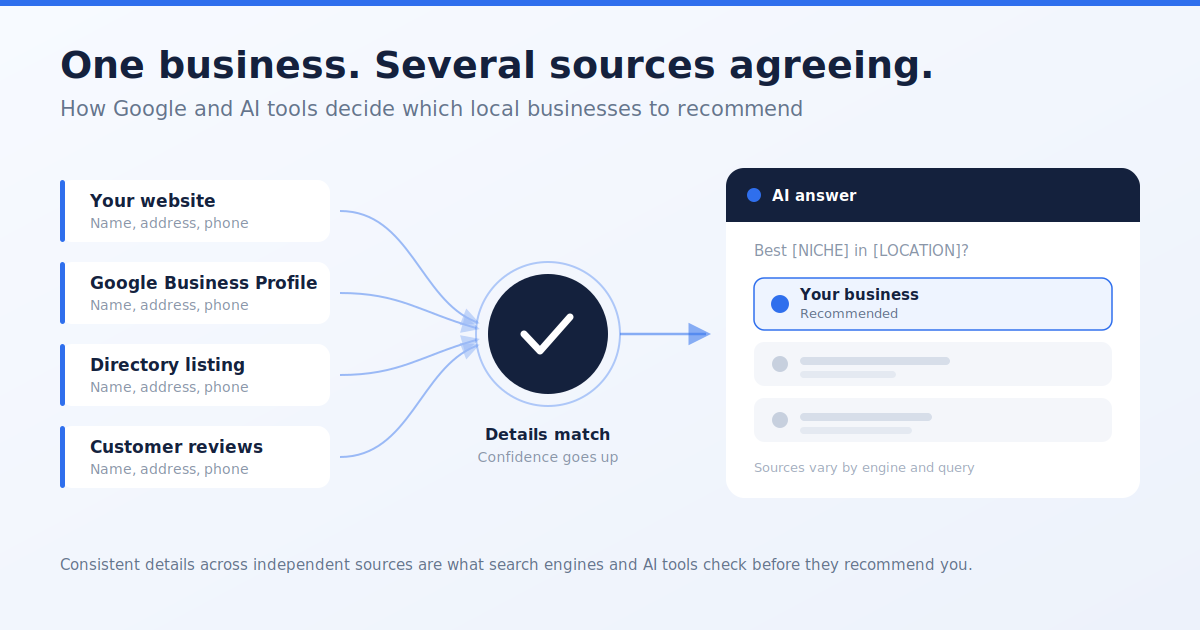
A citation is any online mention of your business name, address and phone number, often shortened to NAP. Search engines treat consistent citations across trusted sites as evidence you are a real, findable business. When your details match everywhere, confidence goes up. When your phone number says one thing in one place and something else in another, confidence drops. The Whitespark Local Search Ranking Factors report, published November 2025 from a survey of 47 local SEO specialists scoring 187 factors, still places citation and on page signals among the things that count, alongside your Google Business Profile and your reviews.
An entity is how Google and AI models actually think about you: not a web page, but a specific business, in a specific place, offering specific services. They build that picture through corroboration, gathering mentions from independent sources and checking whether they agree. One source can be wrong. Five sources agreeing are hard to ignore. Semrush puts it bluntly in its 2025 guidance on generative engine optimisation: off site presence and consistency across the web matter just as much as on page optimisation, because AI tools judge a business partly on what other sources say about it.
GEO, or generative engine optimisation, is the newer subset of SEO. SEO is about ranking in a list of links. GEO is about being named inside an AI answer. The founding academic paper, "GEO: Generative Engine Optimisation" by Aggarwal and colleagues, presented at the ACM SIGKDD conference in 2024 and tested across roughly 10,000 queries, found that including citations, quotations from relevant sources and statistics boosted source visibility by over 40% across various queries. Notably, smaller and lower ranked sites often gained the most, because clean, structured, corroborated information is easy for an AI to lift and cite.
We would add a common sense observation rather than a statistic here. People check a business before they commit, and so do the AI tools answering on their behalf. Being consistently present in the places both look is where the decision is actually made.
The bit most directories gloss over: two different jobs
Here is where a lot of directory marketing gets sloppy, so we will be precise. A do-follow link and an AI citation are two different mechanisms, and the same listing helps with each in a different way.
When one website links to another, that link either passes a vote of confidence, called a do-follow link, or carries a tag telling search engines not to count it, called a no-follow link. Do-follow links help search engines discover your site and can pass a small amount of authority to it. That is a classic SEO benefit, and it is real.
But the rel attribute on a link is not what a language model reads. AI tools mostly work by searching the web and then summarising what they find, so what helps you there is the listing page itself: your name, location, category and services written consistently and marked up in a machine readable way. Semrush's own breakdown of the differences lists backlinks under traditional ranking factors, and lists being mentioned across the web, accuracy and freshness under GEO.
So the honest version of the pitch is this. The do-follow link works on the search engine side. The listing content works on the AI side. Both are worth having, and one listing gives you both, but anyone telling you that a followed link is what gets you into ChatGPT does not understand the mechanism.
What a listing will not do
A directory listing is one input among many, and anyone claiming otherwise is selling you a fantasy. Your Google Business Profile, your reviews and your own website still do most of the heavy lifting. We make no ranking promises and we cannot promise you will appear in any AI answer.
Three further caveats we would rather you heard from us.
AI citation behaviour is unstable. Which sources an engine names changes by engine, by query and by month. Semrush's own testing found ChatGPT and Gemini often answer without showing any sources at all, while Perplexity is citation heavy. There is no single lever that guarantees inclusion anywhere.
Freshness matters more than it used to. Semrush's 2025 comparison notes that evergreen content can stay ranked in traditional search for years, but content generally needs to stay current to keep being cited by AI tools. A listing is not a plaque you hang once. It works best when your details, services and description are kept accurate, which is part of what the subscription is for and why we prompt you to review it.
The Aesthetic Directory is a growing directory, not an established giant. AI tools lean heavily on sources they already recognise. A listing with us is a genuine, consistent, corroborating source for your business from day one, and its pull grows as the directory grows. We would rather set that expectation honestly than have you expect the reach of a national platform priced at £9.99 a month.
Why most directories will not give you a do-follow link!
Most of the big directories a UK business owner would think of apply no-follow to outbound links by default. Yell.com, Yelp UK, Trustpilot, Thomson Local, FreeIndex and similar platforms generally do this. You can pay for a listing and still not receive the one thing a link is best at. Link behaviour does change over time, so it is always worth checking a specific platform yourself.
This is not a loophole on our side. Google's spam policies are explicit that buying and selling links is a normal part of the web for advertising and sponsorship, and is not a violation as long as the links are qualified with a rel="nofollow" or rel="sponsored" attribute value. What Google penalises is paid links passing authority while posing as natural editorial votes.
The distinction that matters is between a real directory and a link farm. A link farm exists only to sell links, lists anybody, and nobody browses it. A curated local directory that vets its listings, organises them by trade and town, and is used by actual people is a different thing, and that is what Aesthetic Directory is built to be.
What you get on the Silver plan for £9.99 a month
A listing in the Aesthetic Directory, curated for genuine location and UK businesses A sponsored do-follow link to your website, which most directories withhold LocalBusiness schema on your listing, so your details are machine readable for Google and AI tools Consistent NAP details that strengthen your wider citation footprint One more independent, corroborating source describing your business correctly The ability to keep it current, which is what keeps it useful
An honest cost comparison
The point of £9.99 a month is not that it replaces Google Ads or an agency. It is that it is an affordable foundation sitting underneath both.
| Option | Typical UK cost | What you actually get |
|---|---|---|
| Silver Listing | £9.99 per month | A maintained do-follow listing, schema and a consistent citation |
| Google Ads for local trades | Roughly £1.50 to £3.00 per click, UK benchmarks 2025 to 2026 | Clicks now, visibility stops when the budget does |
| UK local SEO retainer | Commonly £300 to £500 monthly at entry level, £1,000 to £2,500 for most SMEs | Ongoing strategic work, at a serious monthly commitment |
Put plainly: £9.99 a month is roughly the cost of three to seven Google Ads clicks for a typical UK trade, and unlike those clicks it does not disappear the moment you stop paying attention to it.
Your move...
If you serve customers in the UK and you want Google and AI tools to be able to find, read and confirm your business, a maintained do-follow listing is one of the lowest cost, lowest risk steps available.
For less than a handful of Google Ads clicks - Submit or Claim your do-follow listing on the Aesthetic Directory for just £9.99 a month. and make your business easy for Google and AI to confirm.
A note on our sources
We use UK data wherever it exists. The UK figures here are Ofcom's Online Nation 2025 report, the UK Business Data Survey 2024, the Authoritas study submitted to the CMA, and UK advertising and agency pricing benchmarks. Where only non UK data exists we say so: the SparkToro and Datos zero click study is EU and US clickstream data from 2024, the Semrush studies are global keyword samples, and the GEO academic paper is not country specific. We have not invented any figure, and where a claim is our reasoning rather than research, we have said that too.
Sources Ofcom, Online Nation 2025 (December 2025). 1.8 billion UK ChatGPT visits January to August 2025; around 30% of UK searches showing an AI summary; 53% see them often; 54% of UK adults use AI tools, up from 31%. Sample: UK web traffic plus Ofcom's Adults' Media Use tracker of 7,533 UK adults aged 16 and over. Country: UK. https://www.ofcom.org.uk/media-use-and-attitudes/online-habits/from-apps-to-ai-search-how-the-uk-goes-online-in-2025
Department for Science, Innovation and Technology, UK Business Data Survey 2024. 68% of UK businesses have a website. Sample: 3,911 UK businesses. Country: UK. https://www.gov.uk/government/statistics/uk-business-data-survey-2024/uk-business-data-survey-2024
Authoritas, AI Overviews and UK publishers (July 2025). Click through rate down 47.5% desktop and 37.7% mobile when an AI Overview appears. Sample: 3,500 UK news search terms. Submitted to the CMA; Google disputes the methodology. Country: UK. https://pressgazette.co.uk/media-audience-and-business-data/google-ai-overviews-publishers-report-clickthroughs-authoritas-report/ Semrush, GEO vs SEO (November 2025) and Semrush AI Overviews study. AI Overviews on 13.14% of queries as of March 2025, up from 6.49% in January 2025; guidance on off site consistency, freshness and platform variation. Sample: over 10 million keywords. Country: global. https://www.semrush.com/blog/geo-vs-seo/
SparkToro and Datos, 2024 Zero Click Search Study (July 2024). 59.7% of EU and 58.5% of US Google searches ended without a click. Sample: clickstream panel, September 2022 to May 2024. Country: EU and US. https://sparktoro.com/blog/2024-zero-click-search-study-for-every-1000-us-google-searches-only-374-clicks-go-to-the-open-web-in-the-eu-its-360/
Aggarwal et al., GEO: Generative Engine Optimisation, ACM SIGKDD 2024. Over 40% visibility improvement from citations, quotations and statistics; lower ranked sites benefit most. Sample: GEO-bench, approximately 10,000 queries. Country: global. https://dl.acm.org/doi/abs/10.1145/3637528.3671900
Whitespark, Local Search Ranking Factors (November 2025). Sample: 47 local SEO specialists scoring 187 factors. Country: global expert survey. https://whitespark.ca/local-search-ranking-factors/
Google Search Central, Spam Policies and LocalBusiness Structured Data documentation. https://developers.google.com/search/docs/essentials/spam-policies and https://developers.google.com/search/docs/appearance/structured-data/local-business
UK Google Ads cost benchmarks, 2025 to 2026. Local trades roughly £1.50 to £3.00 per click. Country: UK. https://ppcgeeks.co.uk/ppc/how-much-does-google-ads-cost/
UK local SEO pricing benchmarks, 2026. Entry level £300 to £500; most UK SMEs £1,000 to £2,500 monthly. Country: UK. https://redeagle.tech/blog/how-much-does-seo-cost-uk